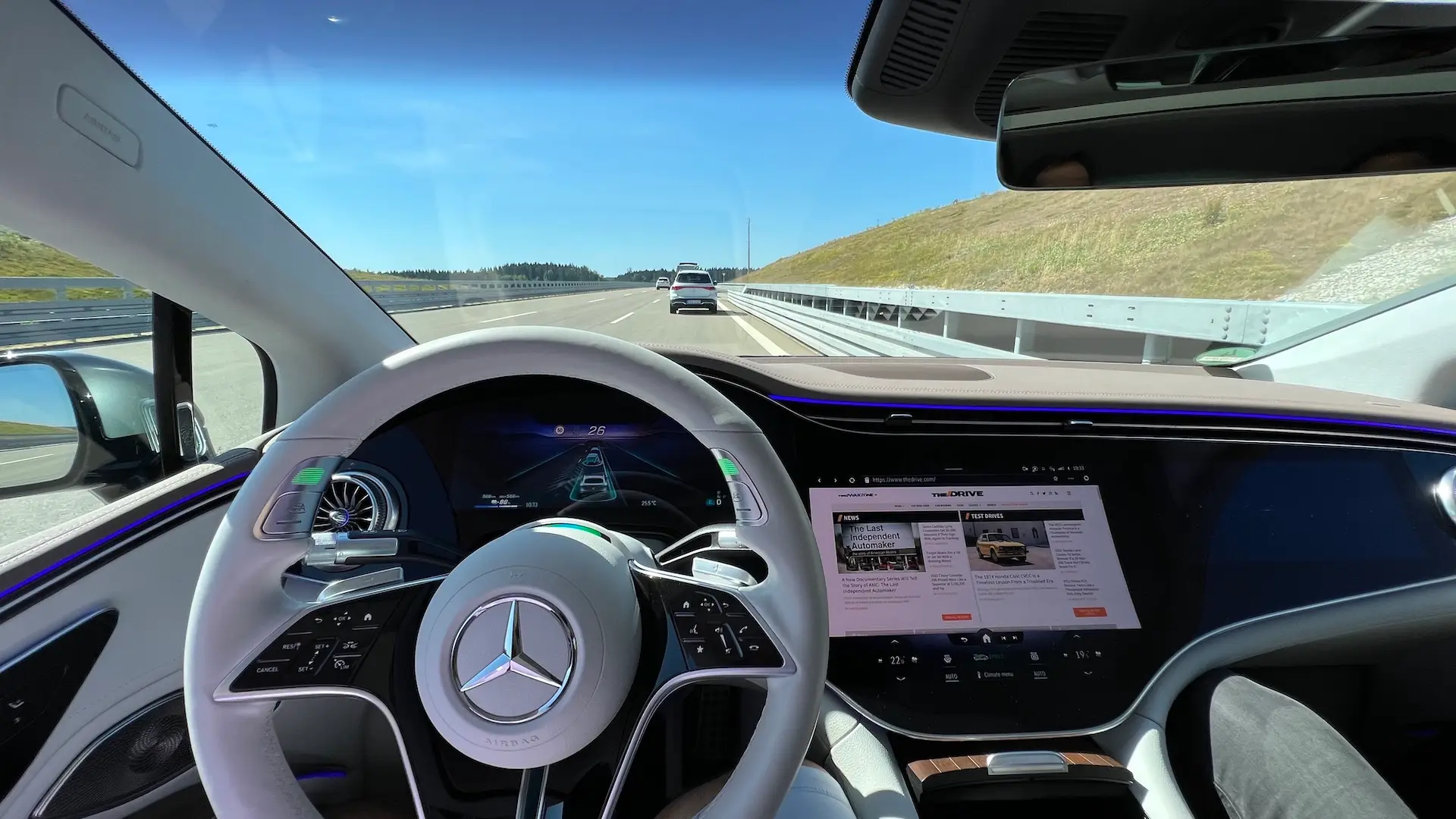
The automotive landscape is witnessing a significant paradigm shift as Mercedes-Benz pivots its autonomous driving strategy. The German luxury automaker is moving away from the highly restrictive, albeit advanced, Level 3 system known as Drive Pilot. Instead, it is doubling down on a new, more versatile technology: MB.Drive Assist Pro . This next-generation system, debuting in the 2026 Mercedes-Benz CLA, aims to deliver a “hands-free” experience not just on highways, but through the chaotic and complex maze of city streets . While it requires more driver supervision than its predecessor, its real-world applicability represents a massive leap forward in the quest for true automotive autonomy.
This strategic shift from the “eyes-off” but limited Drive Pilot to the “hands-off, eyes-on” MB.Drive Assist Pro underscores a crucial industry realization: creating a system that works almost everywhere is currently more valuable to customers than one that works perfectly in almost nowhere . This article delves deep into Mercedes-Benz’s new direction, exploring the technology behind MB.Drive Assist Pro, its real-world performance, the strategic reasons for pausing Level 3, and what the future holds for automated driving.
The Dawn of a New Driving Era: Introducing MB.Drive Assist Pro
Mercedes-Benz has officially unveiled its answer to the modern demand for intelligent driving assistance: MB.Drive Assist Pro. Classified as an SAE Level 2++ system, it serves as a bridge between traditional driver assistance and full autonomy . Unlike the brand’s existing Level 3 Drive Pilot, which legally allows the driver to take their eyes off the road under specific conditions, MB.Drive Assist Pro requires the driver to remain attentive and ready to take over at a moment’s notice. However, the trade-off for this constant vigilance is substantial operational freedom.
The core promise of MB.Drive Assist Pro is point-to-point urban navigation. Drivers can input a destination into the navigation system, and upon activating the assist function, the vehicle will handle a vast majority of the driving tasks . This includes navigating busy city centers, cruising on highways, managing stop-and-go traffic, interpreting traffic signals and stop signs, and executing complex maneuvers like unprotected left turns . It effectively transforms the daily commute from a potentially stressful task into a co-piloted journey.
The system debuts on the all-new 2026 Mercedes-Benz CLA, the brand’s first software-defined vehicle, built on the new Mercedes-Benz Operating System (MB.OS) . This architecture allows for seamless over-the-air (OTA) updates, meaning the system will continuously improve and gain new capabilities long after the car is purchased.
The Technological Marvel Behind the Wheel
To achieve this high level of semi-autonomous driving, MB.Drive Assist Pro relies on a sophisticated fusion of hardware and software that prioritizes safety and redundancy.
A. Sensor Fusion and Computing Power
The system’s “eyes and ears” consist of an impressive array of approximately 30 different sensors . This suite is meticulously engineered to provide a 360-degree view of the vehicle’s surroundings, eliminating blind spots and ensuring robust performance in various conditions. The sensor configuration includes :
-
Cameras: 10 cameras positioned around the vehicle to detect lane markings, traffic lights, signs, and obstacles.
-
Radar Sensors: 5 radar units for measuring distance and speed of other vehicles, functioning reliably in adverse weather.
-
Ultrasonic Sensors: 12 ultrasonic sensors for close-range detection, primarily used for parking and maneuvering in tight spaces.
All this raw data is fed into a central “supercomputer” powered by a collaboration with Nvidia. This platform is capable of a staggering 508 Trillion Operations Per Second (TOPs) . This immense processing power allows the Nvidia Drive AV software to run complex artificial intelligence (AI) models that interpret the sensor data and make split-second driving decisions .
B. The “Cooperative Driving” Philosophy
One of the standout features of MB.Drive Assist Pro is its “cooperative” nature . Unlike some systems that fight the driver for control, Mercedes has designed this technology to be collaborative. If the driver wishes to make a minor steering adjustment—for instance, to give a cyclist more room or avoid a puddle—they can simply steer. The system does not deactivate; it assists with the maneuver and seamlessly resumes control once the driver’s hands are removed from the wheel. This human-like interaction builds trust and makes the technology feel like an extension of the driver’s own intent rather than a rigid autopilot .
C. AI and Safety Redundancy
Safety is the cornerstone of this system. The AI doesn’t just pick one path; it generates multiple potential outcomes for any given situation. As noted during a Car and Driver ride-along, the system evaluates 10 possible scenarios and will only execute a maneuver if at least eight of those models agree on a safe path forward . This “majority rules” approach, combined with the redundancy of having multiple sensor types (cameras, radar, ultrasonics) cross-verifying each other, ensures that the vehicle acts with a high degree of certainty and caution. This safety-first mindset is a deliberate contrast to vision-only approaches, providing what Mercedes calls an “AI-defined car with safety” .
 Conquering the Urban Jungle: A Real-World Experience
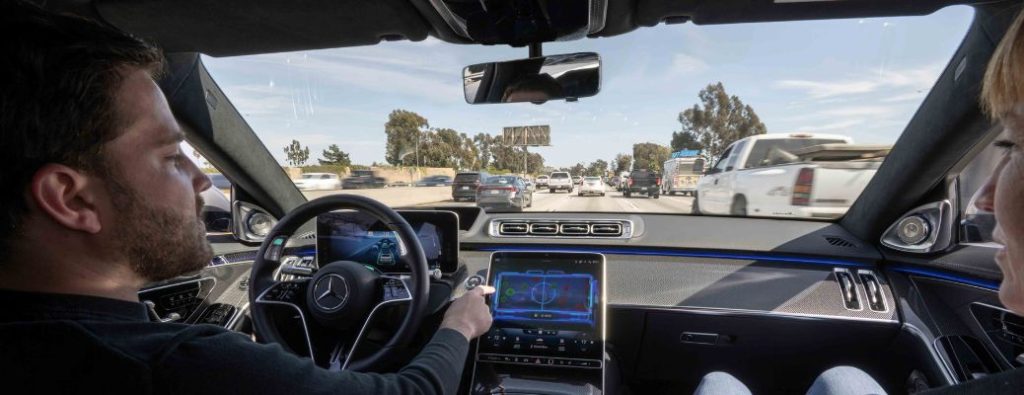
To truly understand the capabilities of MB.Drive Assist Pro, journalists from Car and Driver and MotorTrend were given ride-along demonstrations in one of the most demanding driving environments in the world: San Francisco . The consensus was clear: the system drives with remarkable human-like intuition.
During a 35-minute test drive through the city’s notorious traffic, the system navigated a series of complex scenarios without a single intervention from the engineer behind the wheel . Key observations included :
-
Assertive Navigation: At a four-way stop with multiple cars arriving simultaneously, the CLA hesitated only for a moment before confidently asserting its right of way and zipping through the intersection. It displayed a decisive nature often missing in overly cautious systems.
-
Human-Like Judgment: The vehicle demonstrated a sophisticated understanding of nuanced situations. It smoothly navigated around double-parked delivery vehicles, carefully edged out to provide a wide berth for a cyclist—even crossing a double yellow line when safe—and confidently executed unprotected left turns across hilly terrain.
-
Anticipatory Logic: The system proved it could be smarter than its human passengers. During a lane change maneuver, the CLA’s sensors detected a car rapidly approaching from the rear that the occupants hadn’t even seen. The system instantly aborted the lane change, waiting for the speeding car to pass before safely completing the maneuver .
-
Handling the Unexpected: The true test of any autonomous system is its ability to handle “edge cases.” In one instance, the vehicle encountered a chaotic intersection where a delivery van was backing up as a Waymo robotaxi approached, with pedestrians crossing. The CLA simply observed the混乱, waited patiently, and proceeded only when a safe path was clear .
Mercedes-Benz CEO Ola Källenius himself described a test drive with the system in San Francisco, stating, “It feels like the car is on rails. You’re just driving, and it does everything. I drove uninterrupted for more than an hour through pretty heavy traffic” .
Why Mercedes Paused Its Level 3 Drive Pilot
The introduction of MB.Drive Assist Pro coincides with the quiet pausing of the company’s more advanced, but less practical, Drive Pilot (Level 3) system. Drive Pilot, which launched with great fanfare, allowed for true “hands-off, eyes-off” driving but was shackled by severe limitations . It could only be activated on specific, pre-mapped highways, in dense traffic, at speeds up to 40 mph (later increased to 95 km/h in Germany), and only during clear daylight hours . This narrow Operational Design Domain (ODD) meant that for most customers, the expensive technology offered very little real-world benefit .
A. The High Cost of Limited Utility
Several factors led to the decision to pause Drive Pilot :
-
Prohibitive Cost: The hardware required for Level 3 including expensive LiDAR sensors and redundant steering and braking systems made the option very costly for consumers to purchase.
-
Limited Usability: Because it functioned in such a narrow set of circumstances, most owners could rarely, if ever, use the feature. It became a costly party trick rather than a daily convenience.
-
Supply Chain Issues: Mercedes terminated its supply agreement with LiDAR manufacturer Luminar after the company failed to meet contractual terms, further complicating the future of the system .
-
Shifting Strategy: As a Mercedes spokesperson noted, “We don’t want to offer a system which, customer-wise, doesn’t have much benefits, and we know another system will come with the next two [or] three years with much more customer benefit” .
By shifting focus to the Level 2++ MB.Drive Assist Pro, Mercedes can offer a system that is more practical, less expensive, and usable on nearly every road from city centers to highways while still maintaining a safety-first approach. It represents a strategic retreat from the “perfect but narrow” solution of Level 3 to the “good enough for everywhere” approach of an advanced Level 2 system .
Availability, Pricing, and the Road Ahead
MB.Drive Assist Pro will launch on the 2026 Mercedes-Benz CLA, with availability expanding to other models like the GLC EQ and eventually the facelifted S-Class and EQS . However, its activation is subject to regulatory approval, which Mercedes expects to receive sometime in 2026 .
A. Subscription Model
In a move mirroring industry trends, Mercedes will offer the technology via a subscription model :
-
A three-year subscription for MB.Drive Assist Pro is priced at $3,950.
-
A more basic MB.Drive Assist package is available for $1,950.
-
Monthly subscription options are also planned for those who prefer short-term access.
The system is geofenced to areas where high-definition map data is available, with major West and East Coast metropolitan areas in the U.S. expected to be the first to receive functionality . The version launching in China uses a different software partner (Momenta) to cater to local infrastructure, while the U.S. and European versions rely on the Nvidia stack .
 B. The Future: Level 4 and the “Long Tail”
This pivot to Level 2++ does not mean Mercedes is abandoning its quest for full autonomy. The company, alongside Nvidia, is actively developing Level 4 systems, where the car can drive itself without any human intervention within a defined area . However, CEO Ola Källenius acknowledges the immense challenge, referring to the “long tail” of rare driving scenarios. While achieving 99% functionality is difficult, perfecting the final 1%—the countless edge cases that could lead to accidents—requires enormous effort in data collection, validation, and simulation . The next-generation S-Class, expected around 2028-2030, is the target for introducing this “exceptional Level 4 chauffeur experience” .
C. Communicating Autonomy: The Turquoise Light
As a forward-thinking measure, Mercedes-Benz has already received approval in Germany and parts of the U.S. to test turquoise marker lights for automated driving . When a system like Drive Pilot (or a future Level 4 system) is active, turquoise lights integrated into the headlights, taillights, and side mirrors will illuminate . This signals to other road users and law enforcement that the vehicle is in control. Turquoise was specifically chosen because it is clearly distinguishable from existing red, amber, or white vehicle lights and traffic signals, reducing confusion and building public trust in the technology .
Conclusion: A Pragmatic Step Toward the Future
Mercedes-Benz’s introduction of MB.Drive Assist Pro marks a pivotal moment in the journey toward autonomous vehicles. By pausing the technologically impressive but commercially impractical Level 3 Drive Pilot, the company has made a strategic bet on a system that prioritizes real-world utility and accessibility. While it demands more from the driver requiring constant attention it rewards them with the ability to navigate almost any driving scenario, from winding city streets to open highways, with minimal hands-on involvement .
This new system, powered by a sophisticated fusion of Nvidia computing and an extensive sensor suite, demonstrates that the path to autonomy isn’t just about removing the driver’s responsibilities, but about enhancing their capabilities and comfort in a safe, collaborative manner. As the 2026 CLA hits the roads and OTA updates begin to refine its AI, MB.Drive Assist Pro stands as a testament to Mercedes-Benz’s philosophy: to deliver cutting-edge technology that is not just a showcase of what’s possible, but a practical, reassuring, and luxurious evolution of the driving experience itself. The road to full autonomy is long, but with this new system, Mercedes-Benz has just made the drive a whole lot easier.