The automotive industry is standing on the precipice of its most significant mechanical shift since the introduction of the electric starter. For over a century, the connection between a driver’s foot and the vehicle’s stopping power has been a purely physical one, relying on columns of hydraulic fluid and master cylinders. That era is rapidly coming to a close. Brake-by-wire (BbW) technology is moving from the pages of engineering journals to the showroom floor, promising to redefine vehicle safety, design, and performance . This isn’t merely an upgrade; it is a complete reimagining of one of the most critical systems in an automobile, replacing physical force with digital speed and intelligence.
A. What Exactly Is Brake-by-Wire?
To understand the significance of this shift, one must first understand the system it seeks to replace. Traditional braking systems operate on Pascal’s law, using hydraulic fluid to transfer force. When a driver presses the pedal, a pushrod activates the master cylinder, converting mechanical force into hydraulic pressure. This pressure travels through brake lines to calipers, which then squeeze the brake pads against rotors to create friction.
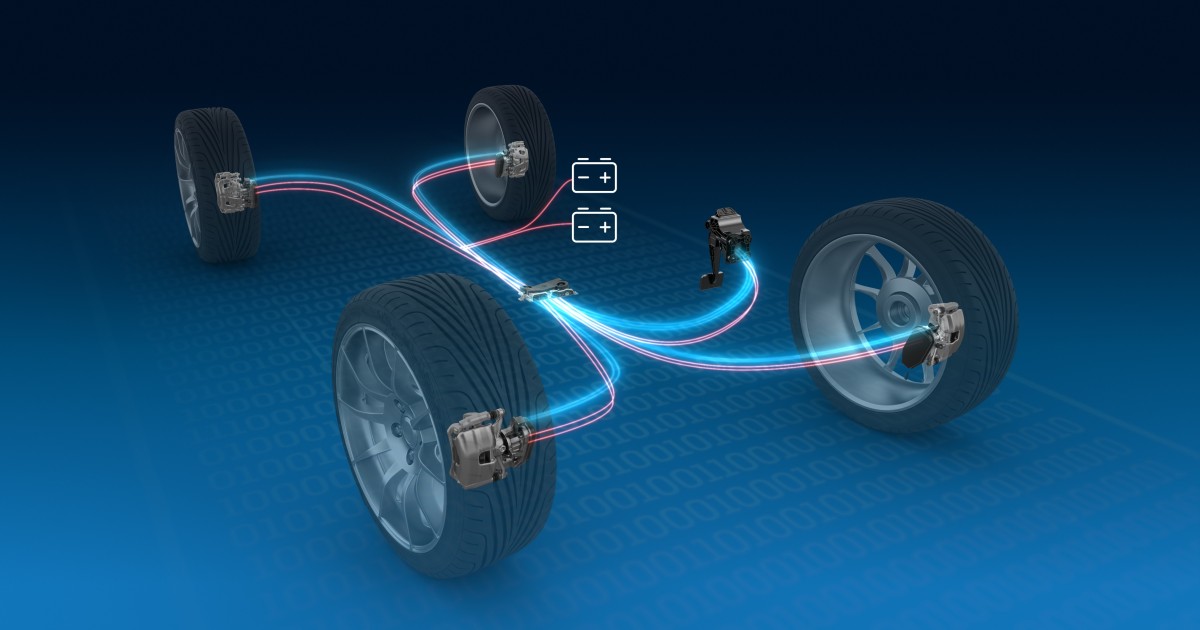
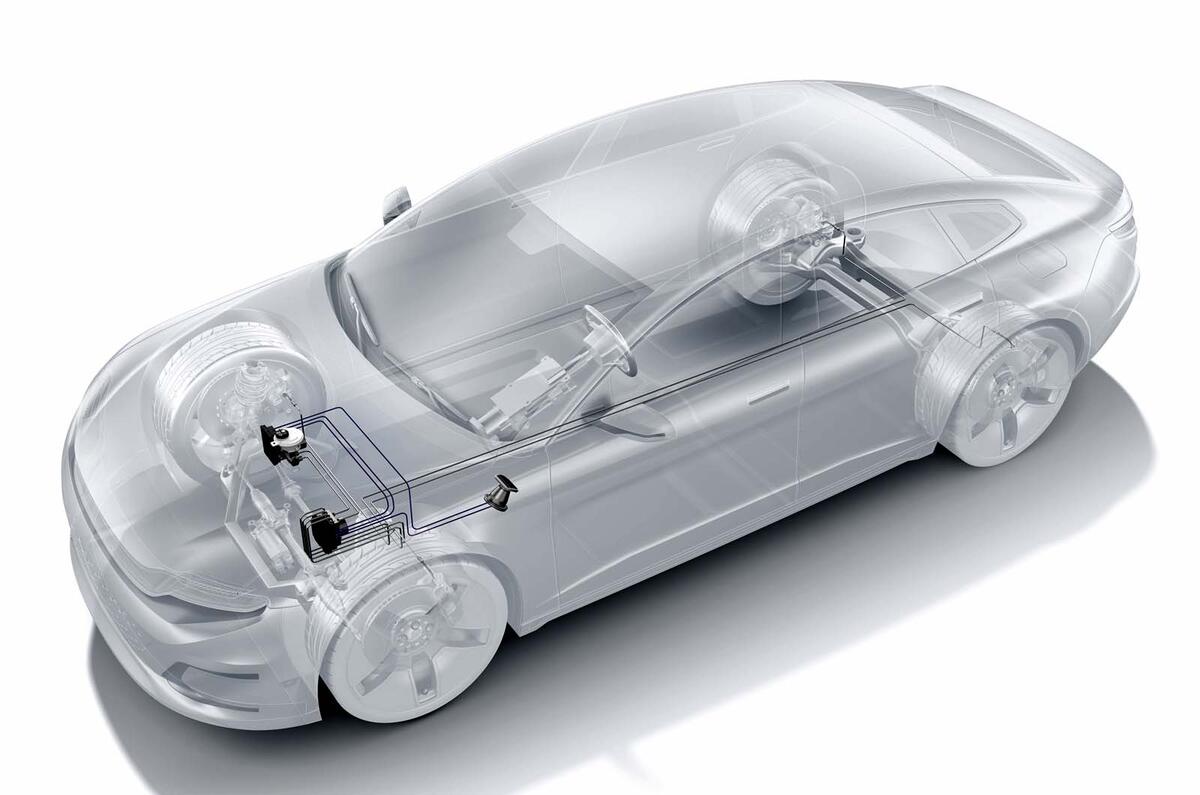
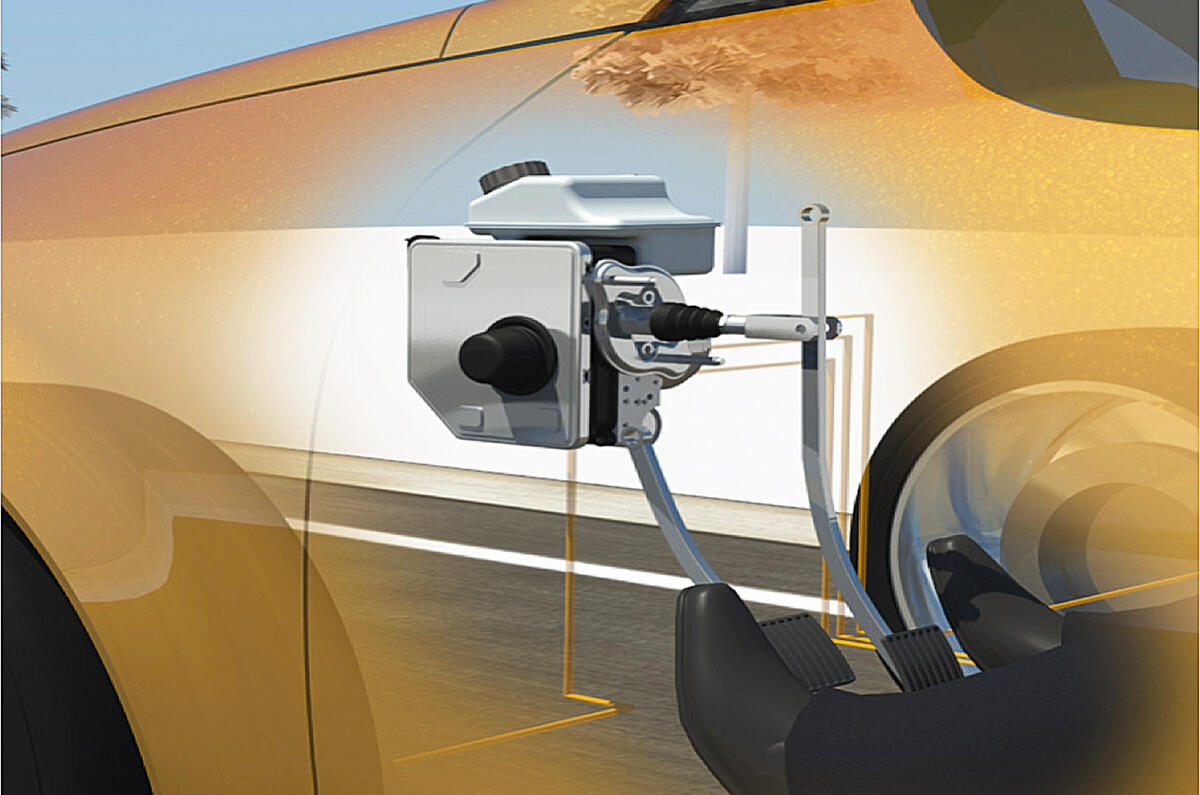
Brake-by-wire severs this physical link entirely. In a true by-wire system, there is no mechanical or hydraulic connection between the pedal and the brakes . It is an electro-mechanical system. When the driver depresses the pedal, the action is detected by a series of redundant sensors (pedal travel sensors and force sensors). This input is converted into an electronic signal and sent to a dedicated Electronic Control Unit (ECU). The ECU processes this signal along with data from other vehicle systems (like speed, yaw rate, and traction) and instantly commands actuators at each wheel to engage the brakes .
In the most advanced iteration often called “dry” brake-by-wire or Electromechanical Braking (EMB) these actuators are high-precision electric motors housed directly within the brake caliper. These motors spin a gearing mechanism to push the brake pad against the disc, generating clamping force independently at each corner .
B. The Two Flavors of Brake-by-Wire: EHB and EMB
The transition to fully dry braking is happening in stages. Currently, there are two primary types of brake-by-wire systems being developed and deployed, categorized by how they generate the final clamping force.
1. The Hybrid Solution: Electro-Hydraulic Brakes (EHB)
EHB systems, such as the one Bosch is launching in late 2025 and Continental’s MK C2, serve as a bridge between old and new . These systems are often called “wet” brake-by-wire or “one-box” solutions. In this setup, the brake pedal is still decoupled from the rest of the system (the driver feels pedal resistance from a spring and a pedal feel simulator). The signal sent by the pedal is electronic.
However, instead of triggering electric motors at the wheels, the ECU activates a high-pressure hydraulic pump and a set of valves to generate hydraulic pressure, which is then sent to conventional calipers to stop the car. While the actuation is digital, the execution remains hydraulic. The primary advantage here is that it removes the need for a vacuum booster and master cylinder from the firewall, simplifying manufacturing and enabling better regenerative braking integration .
2. The Pure Play: Electro-Mechanical Brakes (EMB)
EMB is the “dry” endgame—the holy grail of braking technology. This system removes hydraulics entirely, replacing them with “brakes-by-wire.” As ZF Friedrichshafen and others are developing, these systems rely on powerful electric motors integrated into the caliper to provide the clamping force . Because there are no brake lines or fluid, assembly is simplified, maintenance is reduced, and response times are dramatically faster. However, EMB faces significant engineering hurdles, primarily the need for a 48-volt electrical architecture to provide sufficient power to the motors and the challenge of packaging these robust motors within the space constraints of a wheel rim .
 C. The Core Advantages: Why the Industry Is Switching
The push toward brake-by-wire is not arbitrary. It is driven by a confluence of demands from electric vehicles, autonomous driving, and advanced safety systems that legacy hydraulic setups simply cannot meet efficiently.
1. Supersonic Speed and Safety Precision
One of the most critical advantages of brake-by-wire is its speed. In a hydraulic system, fluid must be compressed and moved, creating a slight delay. BbW systems, by contrast, are virtually instantaneous. According to ZF, electromechanical brakes are far more responsive, particularly in “highly dynamic situations,” such as emergency maneuvers where braking and steering occur simultaneously . This speed is the cornerstone of future safety. For instance, an autonomous emergency braking (AEB) system can activate the brakes milliseconds faster via a by-wire system, potentially shortening stopping distances enough to avoid a collision entirely .
2. The Perfect Partner for Electrification
For electric vehicles, brake-by-wire is a match made in engineering heaven. EVs rely heavily on regenerative braking, where the electric motor runs in reverse to slow the car and generate electricity. This regen feels different from friction braking.
Brake-by-wire systems act as the perfect blending manager. The ECU can seamlessly decide when to use regenerative drag from the motor and when to engage the friction calipers. Because the pedal is decoupled, the driver feels no difference in pedal pressure during this transition, a sensation often described as a “seamless blend” . Furthermore, because BbW can control each wheel independently, it can maximize energy recuperation without destabilizing the vehicle, adding valuable miles to the EV range .
3. The End of “Brake Dust” and “Brake Fluid”
From a maintenance and environmental standpoint, the benefits are clear. Hydraulic fluid is hygroscopic, meaning it absorbs water over time, which degrades its boiling point and leads to corrosion. It must be flushed and replaced periodically. Brake-by-wire (specifically EMB) eliminates this requirement entirely .
Additionally, traditional brakes suffer from “residual drag torque.” This occurs when calipers don’t fully release, causing the pads to lightly rub against the discs. This drag acts as a parasite on fuel economy and EV range. With electromechanical brakes, the system can actively retract the pads to eliminate this friction, ensuring zero drag when the brakes are not applied .
4. Design Freedom and Simplified Manufacturing
By removing the physical master cylinder and servo from the firewall, engineers gain immense flexibility. This component liberation is a massive advantage for automakers. The pedal box can now be a simple electronic unit, allowing for easier conversion between left-hand-drive and right-hand-drive configurations without re-engineering the entire dash and bulkhead. Furthermore, the components can be placed in areas optimized for crash safety, helping to protect occupants better and reduce foot injuries in severe collisions .
D. Addressing the Skeptics: Safety and Feel
For many drivers, the idea of a “digital” brake is unnerving. We are conditioned to trust the physical push of hydraulics. However, manufacturers have implemented rigorous redundancies to ensure these systems are not only safe but also feel familiar.
1. The Redundancy Factor
The automotive industry operates on a fail-operational principle for critical safety systems. Bosch, for example, has engineered its brake-by-wire system with fully redundant signal lines and power supplies. In their “two-channel” system, there are two separate actuators (the by-wire actuator and the ESP unit) that can independently build pressure. If the primary electronic system fails, the secondary system takes over instantly. In the worst-case scenario of total power loss, some hybrid systems still maintain a hydraulic fallback, allowing the driver to apply the brakes mechanically .
2. Replicating the Sensation
Enthusiasts and everyday drivers worry about “feel.” Brake feel is a critical aspect of vehicle dynamics, giving the driver confidence and modulation control. In a by-wire system, since there is no physical connection to the hydraulics, the pedal would simply hit the floor with no resistance.
To combat this, engineers use a “pedal feel simulator.” This is a sophisticated spring and damper mechanism that pushes back against the driver’s foot. The ECU can actually adjust this resistance based on drive modes. In “Sport” mode, the pedal can be made to feel firm and responsive; in “Comfort” mode, it can be softer. This tunability allows manufacturers to perfect the driving experience in ways that fixed hydraulics never could .
E. The Challenges on the Road to Adoption
Despite its promise, the road to a fully dry braking world is steep. The most significant barrier is the “corner module” integration challenge .
1. Power and Packaging
To clamp a brake disc hard enough to stop a two-ton vehicle moving at high speed, you need immense force. Generating that force with an electric motor requires a significant amount of power and a robust gearbox mechanism. Currently, the standard 12-volt electrical systems in most cars are insufficient for high-performance EMB. The industry is transitioning toward 48-volt architectures to solve this, but this requires significant re-engineering of the vehicle’s entire electrical network .
2. Harsh Environments
Brakes live in the harshest environment on a car. They are subjected to extreme heat (from friction), road salt, water, mud, and constant vibration. Packaging sensitive electronics and high-precision electric motors inside a brake caliper that must survive 100,000 miles of this abuse is a monumental engineering task. Reliability in temperatures ranging from arctic cold to desert heat is paramount .
 3. The Transitional Cost
As with any new technology, the initial cost is high. While large suppliers like Bosch predict that 5.5 million vehicles will have BbW by 2030, mass adoption will only occur once the cost scales down to compete with the cheap and robust hydraulic systems that have been perfected for decades .
F. The Future: Integrated Chassis Control
Looking forward, brake-by-wire is just one piece of a larger puzzle. It is part of a suite of “x-by-wire” technologies, including steer-by-wire and ride-by-wire. Bosch and other suppliers are developing centralized “Vehicle Motion Management” software .
In this future, a central computer will oversee all dynamic aspects of the car. If the steering sensor detects the driver turning the wheel, the computer can instantly pre- pressurize the brakes on the inside wheels to help pull the car through the corner. It can adjust the suspension stiffness simultaneously. This holistic control, impossible with isolated hydraulic systems, will lead to levels of safety, comfort, and agility that current cars cannot match. It is the foundational layer required for Level 4 and Level 5 autonomous driving, where the car must be able to stop itself with absolute certainty, regardless of road conditions .
In conclusion, the arrival of brake-by-wire is not just about removing fluid; it is about adding intelligence. It represents the final step in the digitization of the automobile, ensuring that as cars become smarter, their most fundamental safety system is ready to respond at the speed of light.